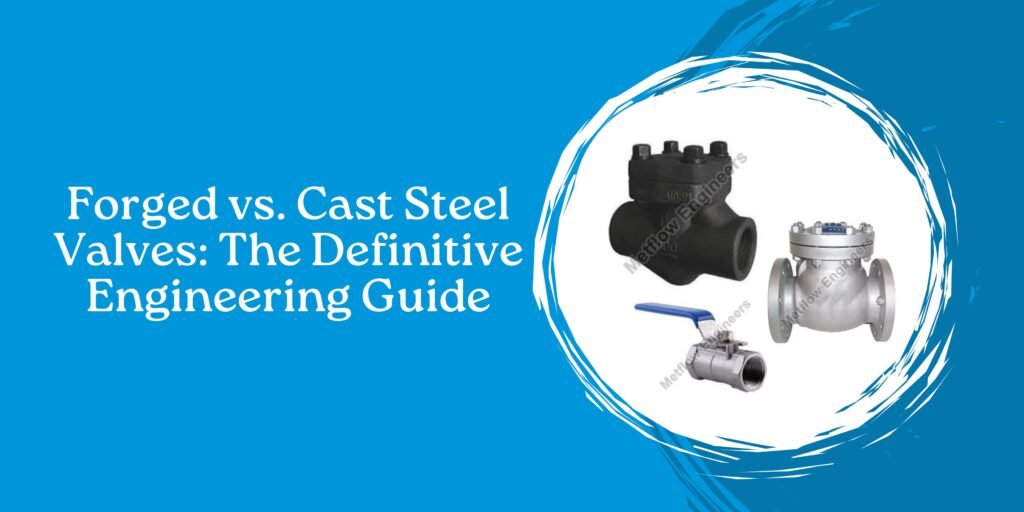
Forged vs. Cast Steel Valves: The Definitive Engineering Guide
When browsing our catalog, you will notice that we offer both Cast Steel and Forged Steel options for our Gate, Globe, and Check valves. While they may look similar once installed, the manufacturing journey of these two valve types creates vastly different performance characteristics.
At Metflow Engineers, we recommend specific types based on your system’s “service severity.” Here is what you need to know to make the right choice.
1. The Manufacturing Process: Strength Through Structure
Cast Steel (The Versatile Foundation)
Casting involves pouring molten metal into a mold. As the metal cools, it solidifies into the final shape.
- The Pros: It is the only cost-effective way to produce complex shapes and large-bore valves (10 inches and above). It allows for intricate internal flow paths that are difficult to machine from a solid block.
- The Constraint: The cooling process can sometimes lead to microscopic “porosity” (tiny gas bubbles trapped in the metal). For general utility or low-pressure service, this is perfectly fine.
Forged Steel (The High-Pressure Champion)
Forging involves taking a solid block of steel and hammering or pressing it into shape under extreme heat and pressure.
- The Pros: The hammering process aligns the metal’s grain structure, making it significantly stronger and more uniform than cast steel. There is zero porosity, meaning the body is virtually immune to gas-leakage through the metal itself.
- The Constraint: Limited by size. Forging is typically reserved for smaller, compact valves (typically 2 inches and below), such as our Forged API 602 Gate Valves.
2. When to Specify Forged vs. Cast
| Feature | Cast Steel Valves | Forged Steel Valves |
|---|---|---|
| Primary Usage | Large-bore lines, utility services | High-pressure/High-temp critical lines |
| Grain Structure | Random, dendritic | Aligned, dense, superior strength |
| Porosity Risk | Possible | Near zero |
| Size Range | Typically 2″ to 48″+ | Typically 1/4″ to 2″ |
| Metflow Product | Cast Steel Gate Valves, Cast Steel Ball Valves | Forged API 602 Gate Valves, Forged Steel Ball Valves, Forged Steel Check Valves, Forged Steel Globe Valves |
3. Engineering Your Decision
The “Service Severity” of your pipeline should dictate your choice:
- Specify Forged When: You are dealing with high-pressure steam, hazardous chemicals, or oil and gas lines where a single “pinhole” leak is catastrophic. The uniform density of forged steel is your primary defense against fugitive emissions.
- Specify Cast When: You need flow control for large-diameter water lines, low-pressure air, or general process media where size and cost-efficiency take precedence over high-pressure resistance.
4. Metflow’s Quality Commitment
Whether you choose the expansive capabilities of our Cast Steel range or the bulletproof reliability of our Forged series, we apply the same stringent quality protocols:
- PMI Testing: We verify the alloy composition before production.
- Pressure Testing: Every valve—regardless of how it was manufactured—is subjected to hydrostatic and pneumatic tests to confirm seat integrity.
Conclusion: Trust the Process
Choosing the right manufacturing process is the first step toward long-term plant reliability. Don’t let a “general purpose” valve become a “point of failure” in your critical process lines.
Unsure which process is right for your upcoming project?
Our technical team is here to review your P&ID (Piping and Instrumentation Diagram) and recommend the correct valve construction for your specific pressures and temperatures.