The Science of Abrasion: How to Select Valves for Slurry Service
Handling slurry is one of the toughest challenges in flow control engineering. When liquid carries suspended solid particles—like ash, ore, or fibers—it creates a constant erosive environment. If your valve design includes “dead zones” or sharp internal turns, those particles will collide with the metal, leading to rapid wall thinning and seat failure.
At Metflow Engineers, we treat slurry applications with a “defense-in-depth” engineering approach.
1. Understanding Erosion: The Three Primary Wear Drivers
Before selecting a valve, you must identify what is destroying your current assets:
- Impacting Wear: Occurs when particles strike the valve surface at high velocity (common at 90-degree turns).
- Sliding Abrasion: Happens as particles “scrub” against the valve surfaces during the opening/closing stroke.
- Corrosive Erosion: The “double-whammy”—where the chemical composition of the slurry weakens the metal, allowing particles to wash away the degraded surface layer even faster.
2. Choosing the Right “Slurry Champion”
Not all valves are created equal when solids are present. Here is the Metflow breakdown for abrasive media:
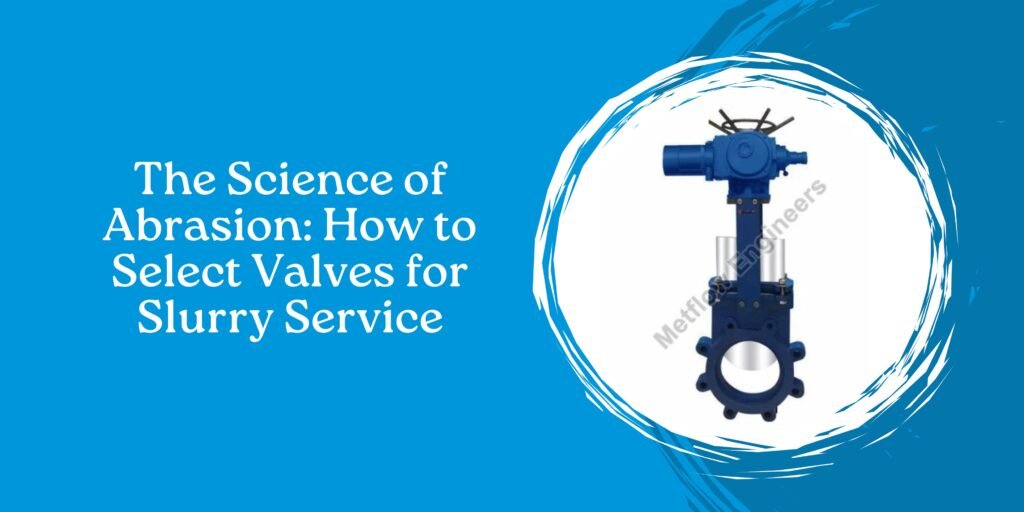
- Knife Edge Gate Valves: The “slurry champion.” Designed for heavy tailings and paper pulp, the sharp blade shears through solids, ensuring a tight seal even when debris is present.
- Metal-Seated Ball Valves: Ideal for high-pressure, abrasive applications. By using hardened coatings (like chrome or stellite), the ball can withstand the constant grinding of sand or ore.
- Pinch Valves: Excellent for fine-particle slurries. Because the slurry only touches a replaceable, flexible sleeve, the metal body of the valve remains untouched by the abrasive media.
3. Material Science: Your First Line of Defense
For abrasive service, “standard” steel often isn’t enough. We prioritize materials that combine hardness with toughness:
- Hardened Internals: We utilize surface-hardened trims and seats. Think of these as a “shield” that forces particles to bounce off rather than gouge the surface.
- Lined Options: For slurries that are also chemically active, rubber or PTFE linings can absorb the kinetic energy of particle impact, acting as a “shock absorber” for the valve.
- Replaceable Components: In slurry service, wear is inevitable. We prioritize designs where seats and seals are easily field-replaceable, allowing you to restore performance without replacing the entire valve body.
4. Proactive Maintenance for Slurry Lines
- Optimize Flow: Avoid “low-flow” or stagnant zones where solids can settle and harden.
- Monitor Vibration: Use vibration analysis to detect the “hiss” of slurry erosion before the valve wall is breached.
- Routine Flushing: If the line is idle, flush it to prevent sedimentation that can “lock” a gate or disc in place.
Conclusion: Don’t Let Abrasion Eat Your Profits
Slurry systems are expensive to run, but they don’t have to be expensive to maintain. By matching the right valve geometry to your specific slurry density and particle size, you can significantly extend your maintenance cycles and reduce total cost of ownership.
Is your current valve fleet failing under the pressure of abrasive slurries? Our engineering team specializes in diagnosing slurry-induced wear and recommending high-performance upgrades. Contact us today for a technical consultation.