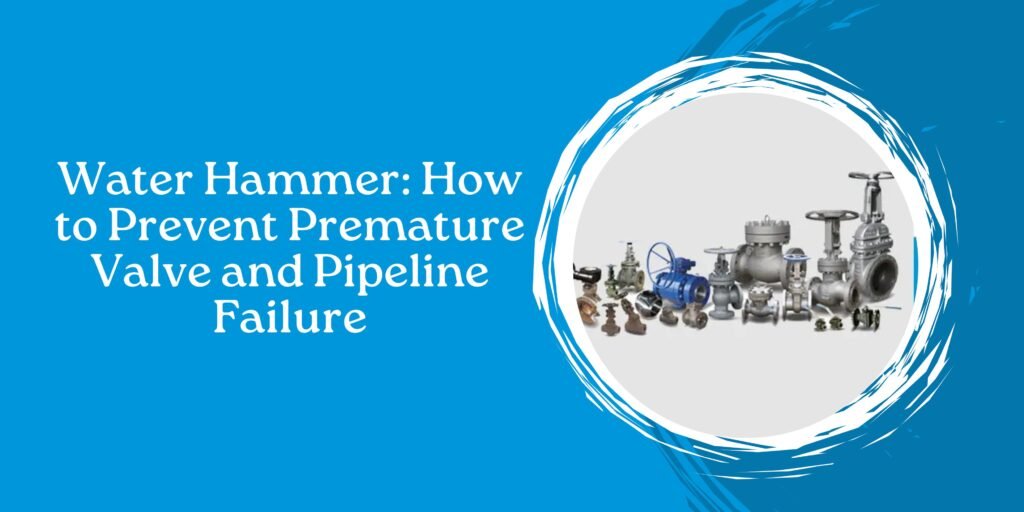
Understanding and Mitigating Water Hammer
In industrial piping, few things are as destructive as Water Hammer (or hydraulic shock). It occurs when a fluid in motion is forced to stop or change direction suddenly. This change in momentum creates a pressure wave that travels through the piping system at the speed of sound, often reaching magnitudes several times higher than the normal operating pressure.
Left unchecked, this surge can lead to:
- Mechanical Failure: Ruptured pipes and fittings.
- Leakage: Blown-out flange gaskets and packing.
- Valve Damage: Cracked discs in Check Valves or deformed seats in Gate and Ball Valves.
At Metflow Engineers, we often see valves returned prematurely due to damage that originated from water hammer. Here is how to diagnose and prevent it.
1. The Anatomy of a Pressure Surge
Water hammer is typically triggered by rapid changes in flow velocity. Common scenarios include:
- Pump Shutdown: When a pump loses power, the column of liquid continues to move forward for a split second before gravity or back-pressure pulls it backward. The sudden “slam” of the Check Valve as it tries to stop this reversal is the most common cause of water hammer.
- Rapid Valve Closure: Closing a large Gate Valve or Ball Valve too quickly can create a sudden blockage, forcing the kinetic energy of the fluid to transfer into a pressure wave.
2. Prevention: The Role of Valve Selection
The right valve selection is your first line of defense against hydraulic shock.
A. Selecting the Right Check Valve
The most critical point of defense is your non-return valve.
- Avoid “Slamming” Swing Checks: In systems prone to high-speed flow reversal, standard Swing Check Valves are notorious for slamming.
- Choose Dual Plate Check Valves: These valves use spring-loaded plates that close before the reverse flow gains significant momentum. This “non-slam” characteristic is essential for protecting pumps.
- Explore our Dual Plate Check Valves for low-slam applications.
- Consider Tilting Disc or Lift Designs: For specific high-velocity lines, specialized check designs can offer even smoother closure profiles.
B. Controlled Isolation
If your process involves large-bore pipelines, avoid quarter-turn valves (like Ball or Butterfly valves) for applications where flow must be stopped slowly. Use a Globe Valve instead.
- Because the disc in a Globe Valve moves linearly, it acts as a mechanical throttle, forcing the operator to close it gradually. This natural “dampening” effect prevents the rapid flow stoppage that causes hydraulic shock.
- See our Stainless Steel WCB Globe Valve range for regulated isolation.
3. Engineering Best Practices
Beyond choosing the right valve, system-level design can neutralize pressure transients:
- Surge Tanks and Accumulators: These act as “shock absorbers” in the pipeline, storing excess pressure and releasing it slowly.
- VFDs (Variable Frequency Drives): Using a VFD on your pump allows you to ramp down the speed (and thus flow velocity) slowly when stopping, rather than cutting the power instantly.
- Air Release Valves: Properly placed air release valves can help dissipate trapped air, which acts like a spring in a pipeline and often amplifies the effects of water hammer.
4. Metflow Engineers: Durable Solutions
Even with the best system design, industrial environments can be unpredictable. That is why our valves—from Cast Steel Gate Valves to Forged Check Valves—are built with high-strength materials and robust internal components designed to survive the occasional pressure spike.