The primary function of a Check Valve (or non-return valve) is deceptively simple: to allow fluid flow in one direction only, automatically closing to prevent backflow. This is critical for protecting pumps, compressors, and heat exchangers from damage caused by reverse flow or the destructive pressure surges known as water hammer.
However, the choice between the two most common designs — the Swing Check Valve and the Dual Plate Check Valve — has a major impact on system performance, installation cost, and water hammer risk.
At Metflow Engineers, we manufacture both designs in materials like Stainless Steel to ensure system integrity. This guide details the comparison, helping you specify the correct check valve for your application.
1. Swing Check Valve: The Classic Design
The Swing Check Valve features a disc that is hinged at the top. When forward flow is present, the disc swings open into the flow path. When the flow stops or reverses, gravity and back pressure force the disc back onto the seat, stopping the flow.
Advantages:
- Low Pressure Drop: When fully open, the flow path is nearly straight, resulting in very low resistance.
- Minimal Maintenance: Simple, robust design with few moving parts.
- Good for Slurries: The large flow path and swinging action help prevent solids from settling in the seat area.
Disadvantages and Water Hammer Risk:
- Slamming Risk: In systems with rapid flow reversal (common in centrifugal pump discharge), the large disc can “slam” shut violently, causing severe water hammer.
- Installation: Must typically be installed horizontally or in a vertical line with upward flow to ensure proper closure by gravity.
Internal Linking Point: Our Swing Check Valves are built for robust performance in pipelines where low pressure drop is essential.
2. Dual Plate Check Valve: The Compact Performer
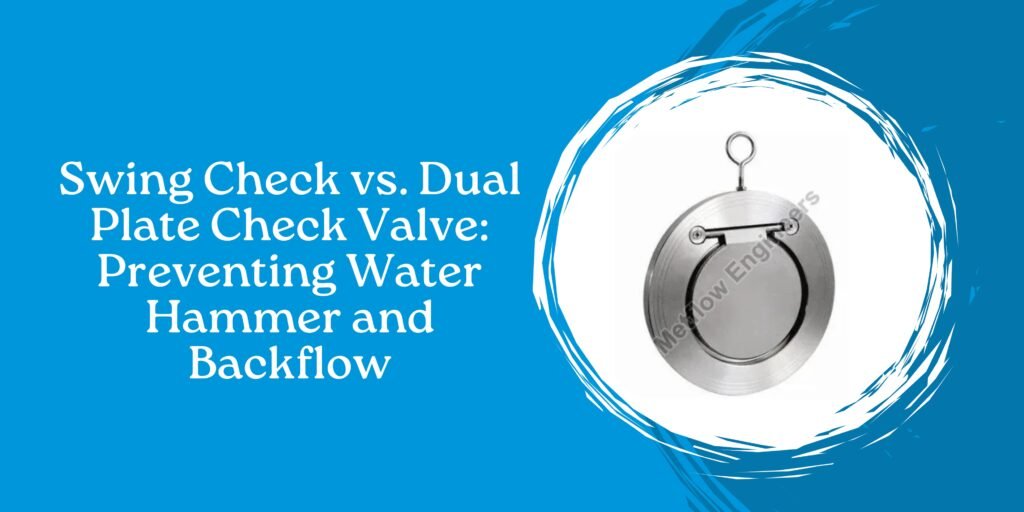
The Dual Plate Check Valve (often called a Wafer Check Valve) uses two semi-circular plates hinged on a central pin. Springs hold the plates closed against the seat. Forward flow opens the plates; when the flow slows, the springs assist the closure, and back pressure completes the seal.
Advantages:
- Excellent Water Hammer Prevention: The spring-assisted closure mechanism enables the valve to close much faster than a swing check, often before reverse flow fully establishes.
- Compact Installation: Its wafer-style design (installed between two flanges) saves significant space and weight.
- Installation Versatility: Can be installed in almost any orientation (horizontal, vertical, or angled) without issue.
Disadvantages:
- Higher Pressure Drop: The plates and central pin create more obstruction in the flow path compared to a fully open swing check.
Internal Linking Point: Our Dual Plate Check Valves and Stainless Steel Wafer Check Valves are ideal for compact, low-slam installations.
3. Comparison Summary: The Decision Factors
| Feature | Swing Check Valve | Dual Plate Check Valve |
|---|---|---|
| Water Hammer Risk | High (Prone to Slamming) | Low (Spring-Assisted Closure) |
| Pressure Drop | Very Low | Moderate (Higher than Swing) |
| Installation | Requires specific orientation (usually horizontal) | Versatile (Any orientation) |
| Space & Weight | Larger and heavier | Compact and Lightweight (Wafer) |
| Service | General utility, good for slurries | Clean fluid, high-velocity gas/liquid |
Conclusion: Matching Valve to Application
The final choice hinges on two main factors: space and flow dynamics.
- If space is restricted and water hammer is a critical concern (e.g., discharge of a multi-pump system), choose the Dual Plate Check Valve.
- If pressure drop must be minimized and the fluid is sluggish or contains solids, the Swing Check Valve is the better solution.
By understanding the distinct closing mechanisms, engineers can select the non-return valve that not only prevents backflow but also protects the entire system from destructive pressure transients.
Ready to specify the perfect check valve for your pump station or critical pipeline?
Contact Metflow Engineers for expert advice on material selection and sizing for our range of industrial check valves.