In critical applications such as power generation, oil and gas processing, and high-pressure chemical units, flow control integrity is paramount. While cast valves are suitable for general service, they pose inherent risks at extreme pressures (typically Class 800 and above) or when subjected to severe thermal cycling.
The definitive solution for these challenging environments is the Forged Valve.
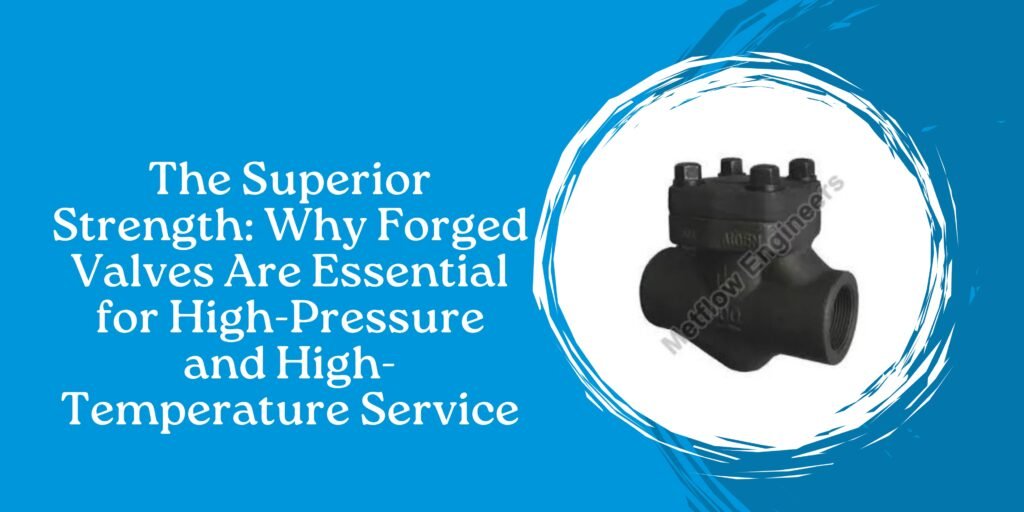
At Metflow Engineers, our line of Forged Valves—including Forged Ball Valves, Forged Gate Valves, Forged Globe Valves, and Forged Check Valves—are produced using a specialized process that eliminates common defects and guarantees superior strength.
Here is a look at the metallurgical and operational advantages of choosing forged valves over their cast counterparts.
1. Forging vs. Casting: The Metallurgical Difference
The fundamental difference lies in how the valve body is formed, which directly impacts the material’s strength and structural integrity.
Casting:
Process: Molten metal is poured into a mold.
Risk: As the metal cools, defects like porosity (small holes) and shrinkage can occur. These defects are invisible and create weak spots that can fail under high pressure.
Forging:
Process: A solid piece of billet (raw metal) is heated to a plastic state and shaped using intense mechanical force (hammering or pressing).
Benefit: This mechanical working refines and compresses the metal, eliminating internal voids. Crucially, it creates a directional grain flow that follows the contours of the valve body, giving it exceptional toughness and resistance to stress corrosion and fatigue.
2. Operational Advantages of Metflow Forged Valves
The superior structure of forged steel directly translates into unparalleled operational performance in high-stakes service.
A. Guaranteed Pressure Integrity (Zero Porosity)
Because the forging process eliminates internal porosity, forged valves are inherently safer and more reliable than cast valves in high-pressure steam, hydrocarbon, and chemical service (e.g., ASME Class 800, 1500, and 2500). The valve body has a uniform, dense structure, ensuring a zero-leak body seal.
B. Superior Mechanical Strength
Forging improves the tensile strength and fatigue resistance of the metal. This is vital in systems that undergo frequent pressure fluctuations or rapid temperature changes (thermal shock), minimizing the risk of bonnet or body deformation.
C. Less Wall Thickness Required
Due to their superior inherent strength, forged steel valves often require less wall thickness than cast valves to achieve the same pressure rating. This results in a lighter, more compact product that is easier to handle and install.
3. Key Applications for Forged Valves
Whenever failure is not an option, the investment in a forged valve is justified. They are the standard for:
Oil and Gas: Upstream wellhead equipment, high-pressure manifolds, and refining units.
Power Generation: High-pressure steam lines and feedwater systems.
Chemical/Petrochemical: High-integrity lines for corrosive or toxic media.
Internal Linking Point: Our Forged Steel Gate Valves and Forged Check Valves are specifically designed to meet the rigorous demands of these critical applications.
Conclusion: Trusting Strength and Quality
Choosing a forged valve is not just about meeting a specification; it is about choosing the highest standard of safety and reliability for your operation. The metallurgical perfection achieved through forging provides a level of integrity that casting cannot match, especially in the challenging environment of high-pressure and high-temperature fluid control.
Ready to upgrade your critical systems with the unmatched strength of forged steel?
Contact the technical experts at Metflow Engineers today for selection and sizing assistance on our complete line of Forged Valves for your next high-pressure project.