The operation of refineries, chemical plants, and upstream oil & gas facilities is governed by two uncompromising rules: system integrity (handling high pressures and temperatures) and environmental safety (eliminating fugitive emissions).
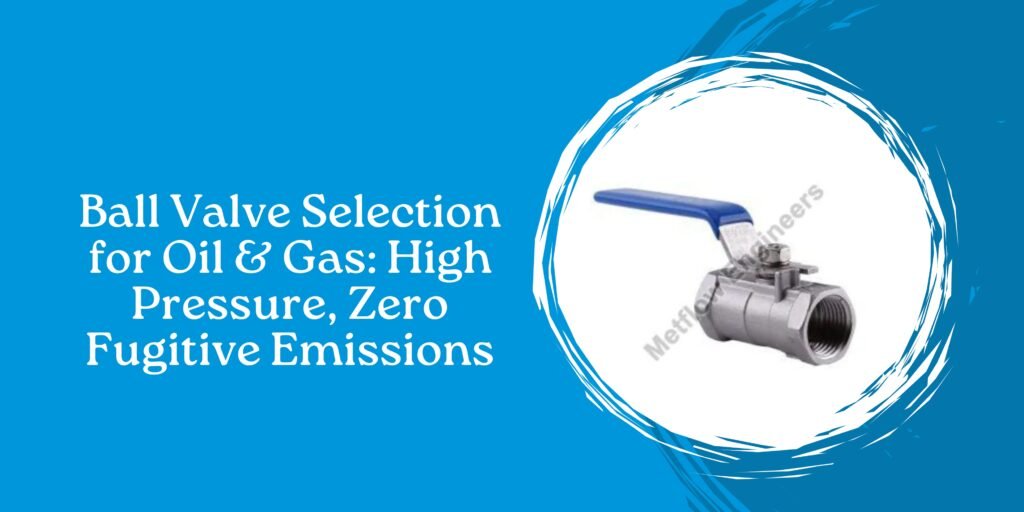
The Ball Valve is the standard workhorse for on/off isolation in these environments due to its quick, 90∘ shut-off capability. However, not all ball valves are created equal. In critical petrochemical service, the valve must be specifically engineered to maintain a reliable seal against thousands of pounds of pressure.
At Metflow Engineers, we supply a specialized range of Cast Steel Ball Valves and Flange End High Pressure Ball Valves built for the demands of this high-stakes industry.
1. High Pressure Integrity: Forged vs. Cast
For petrochemical processes that operate at pressures of ASME Class 600, 800, or higher, the structural integrity of the valve body is paramount.
- Forged Ball Valves (The HPHT Solution): For small-bore, high-pressure lines (typically 2-inch and below), forging is the superior manufacturing process. As detailed in our previous blog, forging eliminates the internal porosity common in casting, guaranteeing the body material will not fail under severe pressure and thermal stress.
- We recommend our Forged Ball Valves for critical lines requiring absolute body reliability.
- Cast Steel Ball Valves (The Large Bore Solution): For larger pipelines (above 2-inch), Cast Steel Ball Valves are commonly used. Quality control in the casting process is essential here to ensure no internal defects compromise the pressure boundary.
- Our Cast Steel Ball Valves are manufactured under ISO 9001-2015 standards to ensure casting quality.
2. Ensuring Tight Shut-off and Sealing
The reliability of a Ball Valve depends on how the ball is supported within the valve body.
- Floating Ball Valves (Low to Mid-Pressure): The ball is suspended by the seats. Line pressure pushes the ball downstream, tightly pressing it against the downstream seat for a strong seal. This is suitable for up to certain pressures.
- Trunnion Mounted Ball Valves (High-Pressure Requirement): In high-pressure applications, pressure forces on a floating ball can be immense. Trunnion Mounted Ball Valves anchor the ball at the top and bottom (the trunnions). Line pressure is absorbed by the trunnions, and the seats are spring-loaded to provide the seal, resulting in lower operating torque and a more reliable seal at very high pressures.
3. Fighting Fugitive Emissions (Stem Leakage)
Fugitive emissions—the unintended release of gases or vapors from seals and packing—are a major environmental, safety, and regulatory concern in petrochemicals.
- Blowout-Proof Stem: A critical safety feature where the stem is inserted from inside the body, making it impossible for internal pressure to eject the stem.
- High-Integrity Packing: Utilizing specialty packing materials (like low-emission PTFE or graphite) and extended bonnets (especially on cryogenic ball valves) helps maintain the seal and meet strict ISO 15848-1 standards for leakage.
- Our Stainless Steel Long Stem Cryogenic Globe Valve utilizes a similar principle to protect the stem seal.
4. Metflow Engineers: Safety and Compliance in Flow Control
In the petrochemical world, a Ball Valve is more than an isolation device; it’s a safety barrier. From high-pressure manifolds to utility lines, choosing a valve with the correct pressure class, material (Stainless Steel for corrosive media), and body construction (Forged for critical service) is vital.
Ready to specify Ball Valves that meet the zero-leak, high-pressure demands of your oil & gas facility?
Contact the Metflow Engineers technical team today to discuss your specific requirements for Forged or Cast Steel Ball Valves.