The primary role of any Check Valve is to prevent backflow and protect upstream equipment. However, in applications characterized by high fluid velocities, rapid flow changes, or specific installation constraints, common check valve types (like the standard Swing or Dual Plate) can struggle or even induce harmful pressure surges known as water hammer.
To solve these niche, high-consequence problems, specialized check valve designs are necessary.
At Metflow Engineers, we manufacture a variety of check valves, including the robust Single Plate Check Valves and our standard Stainless Steel Check Valves, engineered to manage complex flow dynamics and ensure absolute system safety.
1. Single Plate Check Valves: Robust and Low Resistance
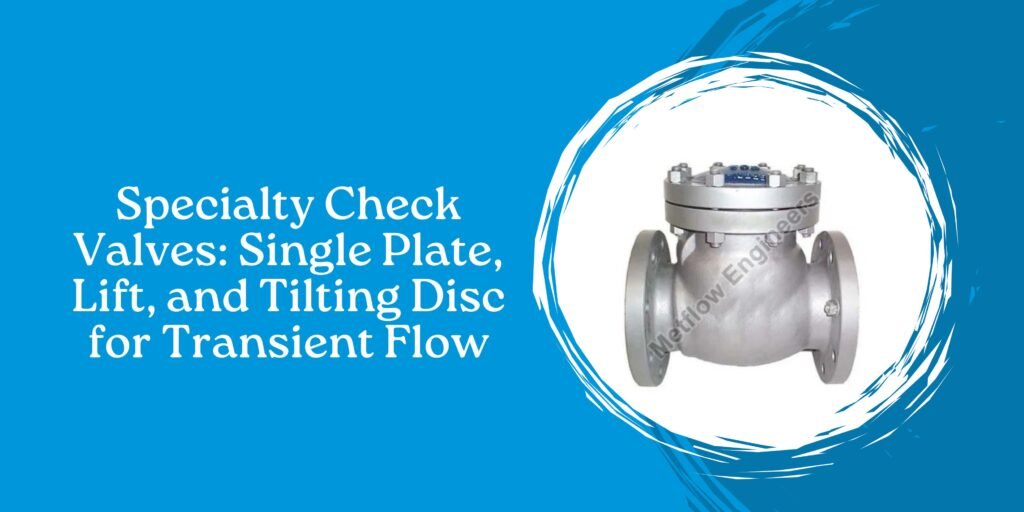
The Single Plate Check Valve is a high-performance alternative to the traditional Swing Check. It uses a single disc that pivots on a hinge offset from the center of the flow path.
Advantages:
Low Pressure Drop: The single, large disc is fully removed from the flow path when open, minimizing resistance and energy loss.
Reduced Slam: The single disc is often designed to have a shorter stroke than a full swing check, which can help it close faster and reduce the severity of slamming (water hammer).
Simple Maintenance: The simple design makes inspection and repair straightforward.
Metflow Products: Our Single Plate Check Valves are often specified for large pipelines where energy efficiency and robust construction are key requirements.
2. Lift Check Valves: Precision for Small Bore
The Lift Check Valve is another form of non-return valve where the closure element (a piston or a ball) moves perpendicular to the flow path.
Mechanism: Forward flow lifts the disc or ball off the seat. When flow stops, gravity and back pressure force the element back onto the seat.
Best For: Small bore, high-pressure applications where tight sealing is critical, especially in steam, air, gas, or liquid lines with high velocity. The guided movement of the piston ensures accurate seating every time.
Contrast: Unlike larger, fast-closing valves, the small lift check valve is effective at high velocity but can be prone to chattering if the flow is too low.
Our Forged Check Valves often utilize a lift-type design to handle HPHT requirements in small diameter lines.
3. Tilting Disc Check Valves: The Ultimate Water Hammer Solution
While not explicitly listed, the Tilting Disc Check Valve is often specified when water hammer is the primary concern in large pump discharge lines.
Mechanism: The disc is mounted on a pivot slightly above its center of gravity. This design allows the disc to “float” in the flow and close gradually as the flow slows down (decelerates), rather than snapping shut when flow stops.
Key Advantage: This slow, controlled closure virtually eliminates the pressure transient associated with disc slamming, offering the best protection against severe water hammer.
4. Selection Criteria for Specialty Check Valves
Choosing the right specialty check valve requires careful analysis of fluid dynamics:
| Design Type | Best For | Key Concern to Address |
| Single Plate | Large lines, low pressure drop | Balancing robust design with some degree of slam reduction. |
| Lift | Small bore, high velocity, vertical flow | Preventing rapid backflow in precise, small-scale systems. |
| Dual Plate | Space-saving, low water hammer | Wafer style installation and quick, spring-assisted closure. |
| Swing | Low-velocity, large lines, slurries | Minimizing restriction (but high slam risk). |
Conclusion: Engineering Safety Into Flow Control
In critical systems, the reliability of the non-return valve can literally determine the safety of your plant. Choosing a specialty design like the Single Plate Check Valve or a compact, spring-loaded Dual Plate Check Valve is essential when flow dynamics are severe. These specialty designs ensure that the valve closes at the precise moment required, protecting your entire system from destructive transient flow events.
Facing a challenging backflow problem in a unique pipeline setup?
Contact the Metflow Engineers technical team today for expert consultation on specifying the perfect check valve to control your transient flow issues.