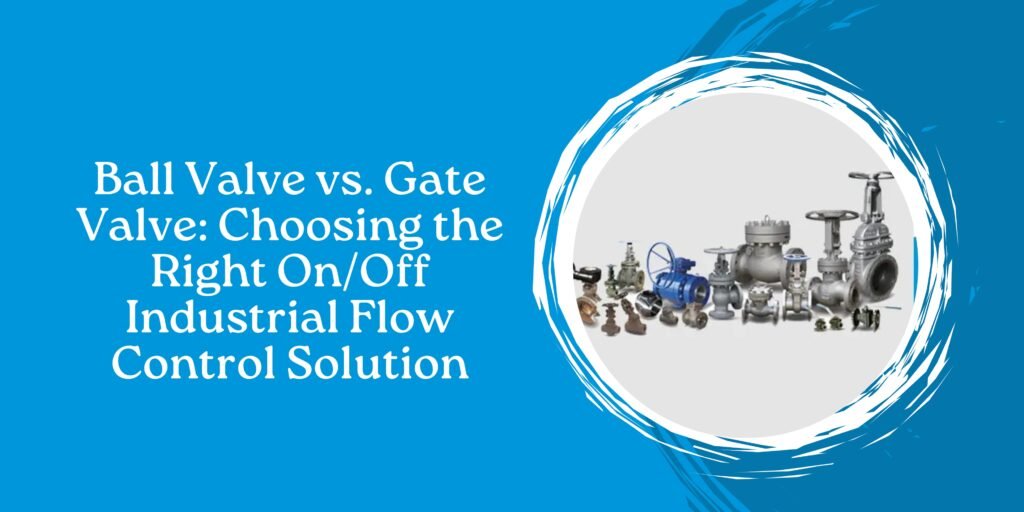
If you’re in procurement, engineering, or maintenance, you’ve likely faced the classic dilemma: Should I specify a
Ball Valve or a
Gate Valve ?
While both are primarily used for
on/off (isolation) service, their internal mechanisms, maintenance needs, and performance in critical applications differ significantly. Choosing the wrong valve can lead to poor flow control, energy loss, and early component failure.
This guide from Metflow Engineers clarifies the key differences, helping you select the perfect
industrial valve for your fluid control needs.
1. The Fundamentals: How Each Valve Works
Understanding the core mechanics is the first step to correct selection.
A. Ball Valves (The Quarter-Turn Specialist)
A
Ball Valve uses a rotational ball with a bore through its center. When the valve is open, the bore aligns with the flow; when closed, the ball is rotated 90° (a quarter-turn), blocking the flow.
- Key Advantage: The quarter-turn action allows for rapid opening and closing, making them ideal for quick shut-off applications.
- Explore our range of Cast Steel Ball Valves for high-pressure service.
B. Gate Valves (The Linear Motion Isolator)
A
Gate Valve uses a flat gate or wedge that moves perpendicular to the flow path. To open the valve, the gate is lifted completely out of the flow stream.
- Key Advantage: When fully open, the flow path is clear (often called “full bore”), resulting in minimal obstruction and low-pressure drop.
- See our reliable Stainless Steel Gate Valves designed for corrosive environments.
2. Key Differentiators for Selection
The true distinction lies in their suitability for specific operational tasks.
| Feature |
Ball Valve |
Gate Valve |
| Primary Function |
Excellent for tight shut-off and quick action. |
Excellent for isolation; must be fully open or fully closed. |
| Throttling Capability |
Poor. Throttling exposes the seat to high-velocity flow, causing erosion and seat damage. |
Extremely Poor. Throttling creates a destructive phenomenon called “wire drawing” on the gate and seats. |
| Pressure Drop |
Low. The flow path is straight and unrestricted when open. |
Very Low (often lower than a Ball Valve). Full bore design minimizes flow restriction. |
| Size & Weight |
Compact and lighter for a given size. |
Taller and heavier due to the long rising stem required to lift the gate. |
| Maintenance |
Generally low maintenance due to robust seating. |
Requires more maintenance on the stem packing/gland due to continuous linear movement. |
3. Application Scenarios: When to Choose Which
Choose a Ball Valve When:
- Quick Shut-off is Critical: Fire safety lines and emergency shut-down systems.
- Tight Sealing is Non-Negotiable: Achieving bubble-tight shut-off is easier due to the ball-seat contact design.
- Fluid is Clean: Ball valves work best with clean liquids or gases where particle buildup isn’t an issue.
Choose a Gate Valve When:
- Full Bore is Required: Piping pigging operations or handling viscous fluids where minimum flow obstruction is essential.
- Pressure Drop Must Be Minimized: In long pipeline runs where every PSI matters.
- Handling Slurries: While Knife Edge Gate Valves are better, standard Gate Valves can handle some non-abrasive slurries better than a Ball Valve.
4. Why Partner with Metflow Engineers?
As an
ISO 9001:2015 certified company, Metflow Engineers adheres to the most stringent
Quality Management System (QMS) standards. Every Ball Valve and Gate Valve we manufacture—from raw material procurement (WCB, SS 304, SS 316) to final pressure testing—is built for longevity and reliable performance.
Whether you need a
Forged Ball Valve for Class 800 high-pressure service or a large-diameter
Industrial Gate Valve for critical isolation, our products meet national and international standards.
Conclusion
While both the Ball Valve and the Gate Valve serve an on/off function, the former offers superior quarter-turn speed and sealing efficiency, whereas the latter provides exceptional full-bore flow with minimal pressure drop. Your final choice should depend on the specific demands of your fluid, pressure, and temperature application.
Need help specifying the right valve material (WCB vs. Stainless Steel) or pressure class?
Contact the experts at Metflow Engineers today for customized valve design and selection assistance.